
Blog
ADAM Audio T5V Studio Monitor Review: Honest Sound for Home Studios

ADAM Audio T5V Studio Monitor Review: Honest Sound for Home Studios
The ADAM Audio T5V brings ribbon-tweeter clarity and bi-amped power to home studios. Here’s why it’s worth the desk space, and who should skip it.
Introduction
Walk into any pro studio and there’s a decent chance you’ll spot ADAM Audio monitors on the meter bridge. The T5V is how the brand lets home studios in on that world, and it doesn’t cut many corners to get there.
Product Overview
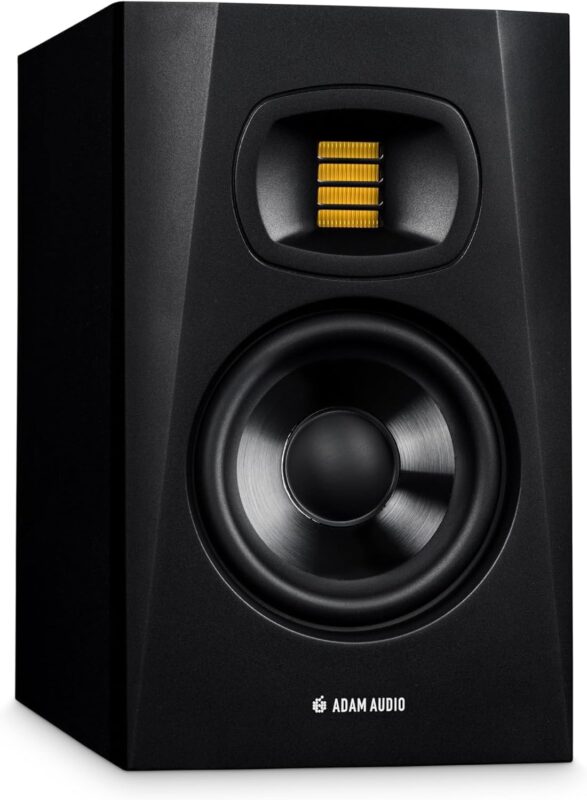
This is a single 5-inch nearfield studio monitor, built around ADAM’s U-ART ribbon tweeter and a woven glass-fiber woofer. It’s not a Bluetooth speaker dressed up in studio clothes; it’s designed for one job: telling you the truth about your mix.
View the ADAM Audio T5V Studio Monitor on Broadcasting Kit →
Key Features
- U-ART ribbon tweeter: a folded-ribbon design normally reserved for monitors costing two or three times as much
- 5-inch woven glass-fiber woofer: tight, controlled bass instead of boomy low end
- Bi-amplification: separate amps for woofer and tweeter, so each driver gets exactly what it needs
- Rear-panel EQ controls: dial in the response for room boundaries, desk reflections, or personal taste
- Balanced XLR and TRS inputs: plays nicely with just about any interface or mixer
Why This Product Stands Out
Most monitors in this price range use a standard dome tweeter, which can get harsh or muddy when things get busy up top; cymbals, sibilance, fine harmonic detail. The ribbon tweeter here unfolds all of that with almost no distortion, so the top end sounds open instead of fatiguing. Add bi-amplification and rear EQ, and you’ve got adjustability that’s usually reserved for pricier gear.
Performance & Real-World Use
Consumer speakers are voiced to sound “exciting”; boosted bass, scooped mids, the works. Great for casual listening, terrible for mixing, because it hides the exact problems your audience will hear on their earbuds or laptop speakers. The T5V doesn’t flatter you. It just tells you what’s actually there. If your monitors sit close to a wall or right on a hard desk, the rear EQ controls alone can clean up a lot of boom or harshness without buying an outboard equalizer.
Who Should Buy It?
- Podcasters, streamers, and voiceover artists working mostly in mono
- Anyone upgrading one channel of an existing pair
- Musicians who already own one T5V and need a matched second unit Musicians mixing in stereo from scratch should grab two, since accurate imaging depends on a matched pair.
Pros & Considerations
Pros:
- Ribbon tweeter detail rivals pricier monitors
- Tight, accurate bass
- Flexible rear EQ
- Compact desk footprint
Considerations:
- This listing is for a single unit, not a pair
- Won’t fix a bad recording, only reveal it
Buying Tips
If you’re building a stereo pair, buy two at once rather than trying to match a second unit later; manufacturing tolerances can shift slightly between production runs. Keep your monitors an equal
distance from each ear and angled inward for the most accurate image.
Frequently Asked Questions
Do I need one or two?
For stereo mixing, get two. For mono podcast or voiceover work, one is genuinely fine.
Will this fix bad audio?
No, and that’s the point. It reveals problems so you can fix them at the source.
Does it need a subwoofer?
Not for most desktop setups. The 5-inch woofer handles typical content-creation needs on its own.
Final Verdict
If you’ve been mixing on headphones or laptop speakers and calling it done, the T5V is one of the most
cost-effective upgrades you can make. It’s not flashy; it’s just honest, and that’s exactly what a monitor
is supposed to be.
