
Blog
KLANG Delivers Immersive Monitoring For NYTW’s “My Joy Is Heavy”

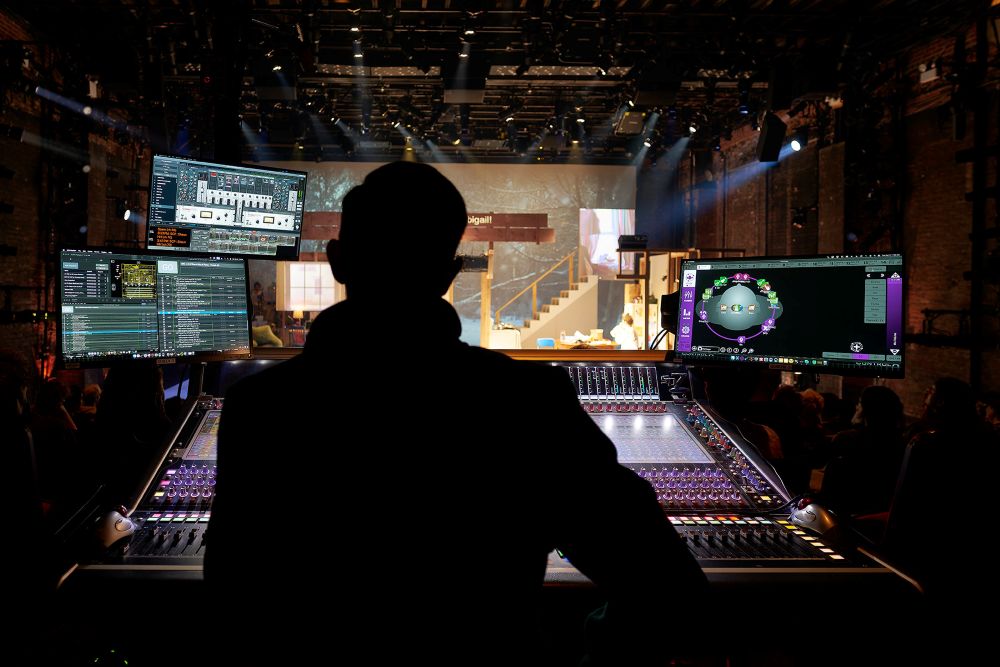
The New York Theatre Workshop’s (NYTW) recent production of My Joy Is Heavy by Obie-winning writing and acting duo The Bengsons (Hundred Days, The Keep Going Songs) saw all six performers in the production delivered immersive in-ear monitor mixes in a setup comprised of seven KLANG:kontrollers up on the stage, fed by a DMI-KLANG card plugged into a DiGiCo Quantum7T mixing console at front of house.
Described by New York Stage Review as an “80-minute musical memoir,” the show was billed by NYTW as “a raucous, funny, and tender indie-folk-punk show about grief and healing.” One of the challenges of a production like My Joy Is Heavy, staged at NYTW’s venue in the city’s Bowery district, was to examine multiple layers of emotion through a complicated and crowded set design. On stage, the show featured all cast members and actors, including creators Abigail and Shaun Bengson, collectively singing and playing guitar, bass, drums, trumpet, trombone, reeds, accordion, and various other instruments.
To best manage a complex audio signal flow while being responsive to the performers, sound designer Nick Kourtides opted to deploy the KLANG immersive IEM platform, where it helped the entire ensemble work together seamlessly. “The show was definitely challenging for monitoring, but KLANG helped us bring all elements together,” says Kourtides, adding that colleague vendors Masque Sound and Autograph A2D were “instrumental in supporting the KLANG deployment.”
A significant innovation was building the full-stage audio environment during studio rehearsals, eliminating the usual disconnect between rehearsal and live performance. All performers were able to quickly adapt to the system with minimum technical support.
“KLANG’s intuitive design and spatial audio mixing improved clarity, reduced cognitive load, and allowed performers to make better musical decisions in real time,” says Kourtides. Instead of relying on heavily compressed, hard-panned mixes, performers experienced a natural, localized soundscape, leading to better dynamics and less need to pull an earpiece out to check in on reality.
KLANG also offered clearer, less fatiguing mixes. This was especially relevant given one performer’s progressive hearing loss. The broader production incorporated accessibility elements like live captioning and multiple sensory entry points.
Ease of use and simplicity of operation were duly noted by the performers. Kourtides: “There were no DIP switches, no ‘hold this button down while you boot’—none of that. The musicians very quickly adapted to the logic of the :kontroller interfaces. And I made almost no adjustments to their mixes after seating—a first for me.
“KLANG really unlocked their ability to play a dense mix, against vocalists who are singing at various volumes,” he continues. “This is modern music—rock drums, electronics, synths—there’s a lot going on, so anything that removes barriers puts the musicians in a position to make good creative decisions. KLANG simply does not get in the way. And it lets the music work like music for the instrumentalist; they’re not trying to play against what they’re hearing. They’re getting the articulation and sheer legibility of a localized mix. You cannot ask for anything better.”
KLANG